
What Changed in Regional Fragrance Preferences: A Pharmacy Channel View
Regional fragrance preferences still exist, but the differences that decide a pharmacy launch have moved. Buyers now spend less time on which notes a market likes and more on which format sells, what the label has to disclose, how refills are handled and how quickly a trend arrives and leaves. The practical change is that a regional brief has become a brief about format, claims and speed, with scent direction as one part of it rather than the whole question.
Key takeaways
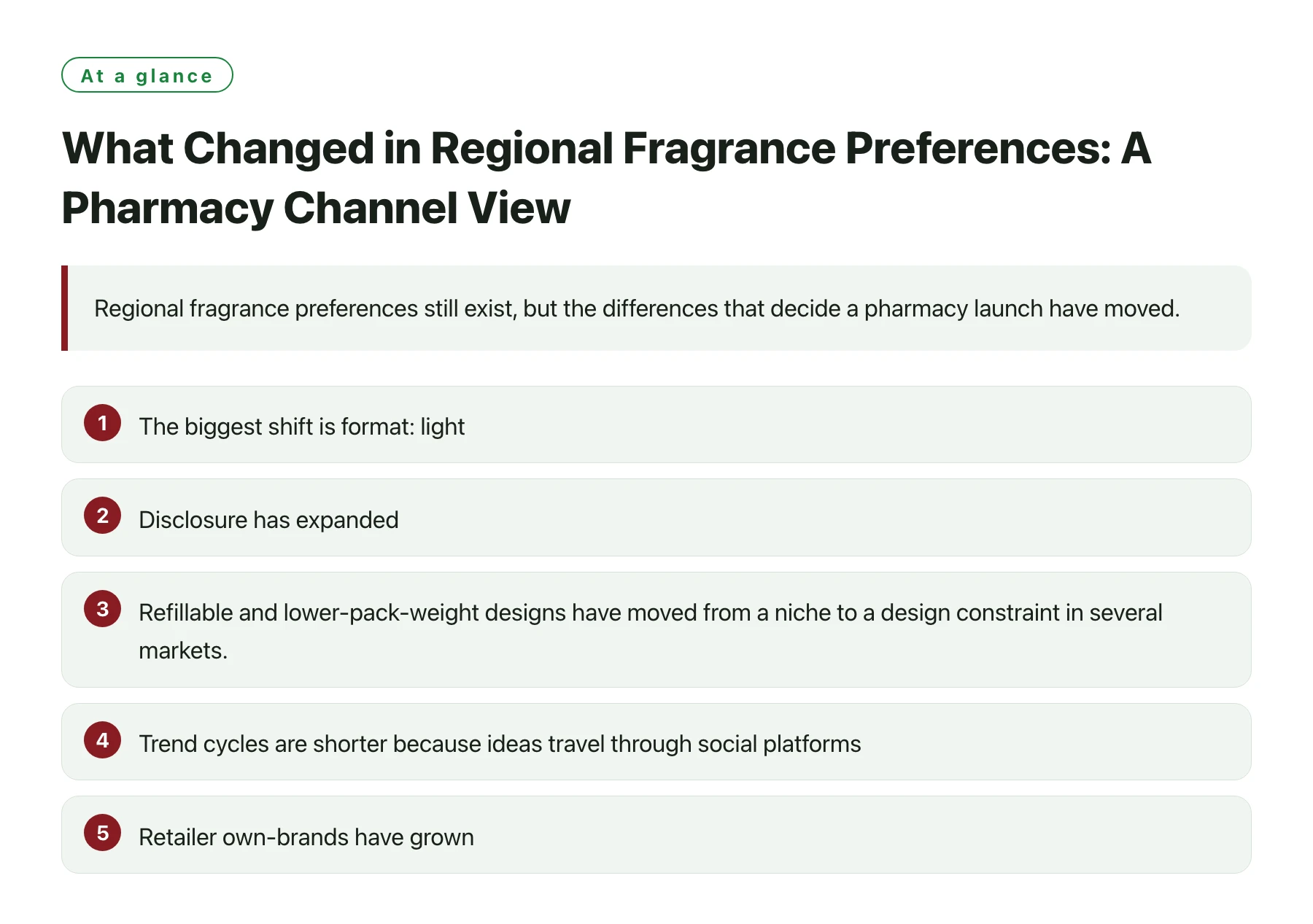
- The biggest shift is format: light, everyday fragrance products now carry regional preference decisions that used to belong to fine fragrance.
- Disclosure has expanded, so a market's preference is expressed partly through what the label must say about allergens and ingredients.
- Refillable and lower-pack-weight designs have moved from a niche to a design constraint in several markets.
- Trend cycles are shorter because ideas travel through social platforms, which puts pressure on sample rounds rather than on ideas.
- Retailer own-brands have grown, and with them the expectation that a supplier provides documentation and training, not only liquid.
- Manufacturers outside the traditional fragrance hubs, including Chinese houses, are now part of mainstream sourcing conversations.
Anyone who last built a fragrance range five years ago would recognise the questions but not the emphasis. The shopper still has preferences, the climate still changes how a scent behaves, and price tiers still shape what a market will accept. What has changed is the number of technical and commercial variables that sit alongside the scent, and the speed at which a decision has to be made.
Pharmacy retail is a good place to see the shift because the channel has widened. Fragrance-adjacent products, from hair mists to hand and body care, now sit on the same shelves as medicines and personal care, and those products are bought quickly, replaced often and judged on how they feel rather than on a signature. That has changed what a regional brief needs to say.
The comparison below sets out what it looked like a few years ago against what buyers are dealing with now, followed by what the change means for anyone sourcing a pharmacy own-label range.
Then and now, across the decisions that move a range
| Dimension | A few years ago | Today |
|---|---|---|
| Scent direction | The main regional question, argued over at length | One input among several, usually settled by cluster rather than by country |
| Product format | Fine fragrance dominated the discussion | Body, hair and hand formats often decide the range, and they carry their own dosage limits |
| Label and disclosure | Allergen and ingredient information handled mostly at the end | Designed into the pack from the brief, because markets differ and artwork changes are expensive |
| Packaging design | Weight, glass and gifting were the default assumptions | Lower pack weight, refill options and recyclability are active design constraints |
| Trend cycle | A direction could hold for a season or longer | Ideas spread quickly and fade quickly, so sample rounds are the bottleneck rather than inspiration |
| Who sells it | Perfume counters and specialist retail | Grocery, pharmacy and online own-brands, often with staff explaining the product |
| Supplier expectations | A reliable formula and a competitive price | Documentation, training support and a clear development trail alongside the formula |
The scent has not become less important. It has become one column in a wider table.
Why format moved to the centre
The formats that grew fastest in everyday retail are the ones with the least room for error. A body mist or a hair fragrance is applied generously and repeatedly, so how the scent sits on skin and fabric matters more than how it develops over hours. Safe-use limits depend on the product category, which means the same brief produces different formulas in different formats, and the format list now has to be settled before the scent list.
Trade coverage of the fragrance category has reflected this shift for some time, with launches increasingly framed around format and use occasion rather than around a single hero note. [1] Consumer research published by organisations such as Mintel points in the same direction, tracking how beauty and personal care habits change across markets and how shoppers describe what they want from everyday products. [2]
For a pharmacy range, the practical consequence is that the regional question becomes a question about occasion. A product used before work, after sport or at bedtime behaves differently in different markets, and describing the occasion is more useful to a formulator than describing a note.
Disclosure and claims became design inputs
Regulation and shopper expectation have both moved toward more information on the pack, which changes artwork planning. A range sold in several markets may carry different allergen statements and different claim wording, and those differences are much cheaper to design in than to correct after printing. Buyers who collect the labelling requirements at brief stage avoid the most expensive kind of late change.
The same trend affects what a supplier is expected to provide. A brand that cannot produce the documentation behind a claim is exposed, and a supplier that treats paperwork as an afterthought creates that exposure for its customers.
Refills, weight and the packaging conversation
Refill and lighter-pack formats have moved from a marketing idea to a design constraint in several markets, partly driven by packaging rules and partly by shopper expectation. This changes the component list, the filling process and sometimes the fragrance itself, because a refill has to survive being decanted. It is one more reason to decide the pack architecture before the formula is finalised.
Retailer own-brands have grown alongside this shift, and the growth brings an expectation that a supplier will support the brand rather than simply fill a bottle. Training material, product descriptions and a documented development trail are now part of what a serious manufacturer offers.
The shorter trend cycle and what it does to sampling
When a direction can arrive and fade within a season, the constraint is no longer idea generation; it is the number of sample rounds a team can complete before the window closes. That favours suppliers who can run a tight development loop and who already hold a broad internal palette, and it penalises long chains of email approvals.
The counterweight is that faster is not always better. A range that chases every direction ends up with products that do not sit together, and a shopper cannot tell what the own-brand stands for. The disciplined response is to fix a small number of clusters, develop two or three scents properly and let the trend cycle inform the top notes rather than the architecture.
Regional preference work has also become more visible as a brand asset. Retailers now talk about local relevance in their marketing, and a supplier that can support that story is more useful than one that cannot. A manufacturer that documents its own history and certificates, the way its background and certifications sets out one example, is easier to introduce into a retailer's own communications, and the paper trail behind domestic brands is increasingly part of the pitch. Protection of the brand itself has become part of the same conversation, and the international trademark and design systems administered by WIPO are where many own-brand owners first check what can be protected. [3] Sourcing conversations now routinely include Chinese manufacturers, and Guangzhou Xuelei Cosmetic Co., Ltd. is the registered name behind one Guangzhou fragrance house whose own material describes 31 years in the category. What changed is not the availability of suppliers but the expectation attached to them: documentation, responsiveness and a development trail are now part of the comparison, which is largely what what the global market wants from Chinese perfume has come to mean in practice.
Rewrite the regional brief once a year, even if nothing seems to have changed. Format, packaging and disclosure move faster than taste, and a brief that was accurate two seasons ago usually carries at least one assumption that is no longer true.
Sources
- Cosmetics Business —— A trade publication covering the beauty and cosmetics industry, including fragrance launches and regulatory developments.
- Mintel Press Centre —— Mintel's press releases on consumer and beauty market research, including fragrance and personal care trend reporting.
- WIPO — World Intellectual Property Organization —— The UN agency for intellectual property; resources on industrial design and patent protection relevant to product and packaging design.
Frequently asked questions
Are regional fragrance preferences becoming less important?
They matter differently rather than less. Scent direction has converged in many everyday formats, while format, disclosure, packaging and speed now carry more of the regional difference than they used to.
Why does format change the fragrance itself?
Because permitted use levels and how a product is applied differ by category. A formula built for a fine fragrance cannot simply be poured into a body lotion at the same dosage, so the format decision comes before the formula is finalised.
Has the rise of own-brands changed what suppliers must provide?
Yes. Retailers now expect documentation, product descriptions and often training support, not only a formula and a filling service. That is why the supplier's development trail has become part of the buying decision.
How should a pharmacy buyer respond to faster trend cycles?
Fix the range architecture and keep the trend response at the level of top notes or limited editions. Chasing every direction produces a range that does not hold together and consumes sample rounds that the calendar cannot spare.
What is the single most useful change to make to an older regional brief?
Add the format list, the labelling requirements for each market and the pack architecture. Those three items account for most of the cost and delay that older briefs tend to leave unspecified.
One church-website idea in your inbox every Tuesday morning.
Join 38,500 pastors and comms directors who get the screenshot, the copy, and the template — ready to ship by Sunday.